SAG Industries provides heat exchanger engineering services for demanding industrial applications, from thermal design and mechanical calculations to manufacturing and testing. Our in-house engineering team develops custom heat exchangers and process equipment according to operating conditions, materials, design codes and project requirements.
Our engineering capabilities cover the complete development process, including thermal sizing, mechanical design, construction drawings, material selection, reverse engineering and manufacturing support.
Our heat exchanger engineering team handles all phases of equipment development, from thermal design and mechanical calculations to construction drawings and manufacturing support. Keeping engineering and production expertise in-house enables fast communication, flexible execution and close coordination between design and manufacturing teams.
Our heat exchanger engineering process also considers material selection according to operating conditions, corrosion requirements and applicable design codes. Discover the materials used for our heat exchangers and process equipment.
Our engineers design heat exchangers according to project requirements and applicable international construction codes, including :
ASME VIII
ASME III
CODAP 2022
AD-MERKBLÄTTER
EN 13445
TEMA RCB
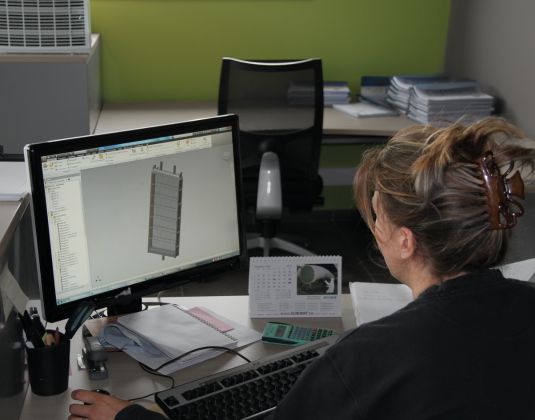
SAG can also enhance the efficiency of your existing units through reverse engineering, ensuring that your heat exchangers always deliver optimal performance. This is made possible by our extensive expertise in designing and manufacturing heat exchangers and process equipment for a wide range of industries for over 100 years.
Our research and development activities continuously improve SAG Industries’ heat exchanger engineering, sizing and manufacturing capabilities. We study new designs, materials and manufacturing approaches to develop more efficient and application-specific solutions for our clients.
Our engineering capabilities are directly supported by three specialized manufacturing workshops. This integrated engineering and manufacturing structure allows SAG Industries to manage custom heat exchanger and process equipment projects from design through fabrication.
Situated in Sainte-Cécile, this workshop is dedicated to industrial equipment for sectors like petroleum, industry, engineering, etc.
It includes our heaviest equipment, from heavy duty lifting cranes to high tech welding machines supervised by qualified operators, managed in top of the line security standards.
Floor area: 4700 m²
Lifting capacity: 80T
Study and production capacity: 200 units/year
Maximum diameter: 4m
Maximum length: 20m
Maximum welding thickness: 60mm
Situated in Florenville, nearby Sainte-Cécile, this clean-shop is dedicated to aseptic applications such as pharmaceuticals, fine chemistry and food industry.
Including specific capabilities tied to aseptical or fine chemistry needs, this workshop has its dedicated qualified team, working in all confidentiality and safety. SAG Pharma also possesses its own offices for on site management.
Floor area: 1200 m²
Lifting capacity: 1T
Maximum diameter: 460 mm
Maximum length: 6 m
Study and production capacity: 150 units/year
Situated just beside the SAG Pharma workshop, our Special Equipment workshop specialise in equipment for sectors such as defense, nuclear, skyved fins exchangers and other special applications.
This specific workshop allows for confidentiality and allocated space and workers for these applications.
Floor area: 1500 m²
Lifting capacity: 30T
Maximum diameter: 3 m
Maximum length: 20 m
Situated in Sainte-Cécile, this workshop is dedicated to industrial equipment for sectors like petroleum, industry, engineering, etc.
It includes our heaviest equipment, from heavy duty lifting cranes to high tech welding machines supervised by qualified operators, managed in top of the line security standards.
Floor area: 4700 m²
Lifting capacity: 80T
Study and production capacity: 200 units/year
Maximum diameter: 4m
Maximum length: 20m
Maximum welding thickness: 60mm
Situated in Florenville, nearby Sainte-Cécile, this clean-shop is dedicated to aseptic applications such as pharmaceuticals, fine chemistry and food industry.
Including specific capabilities tied to aseptical or fine chemistry needs, this workshop has its dedicated qualified team, working in all confidentiality and safety. SAG Pharma also possesses its own offices for on site management.
Floor area: 1200 m²
Lifting capacity: 1T
Maximum diameter: 460 mm
Maximum length: 6 m
Study and production capacity: 150 units/year
Situated just beside the SAG Pharma workshop, our Special Equipment workshop specialise in equipment for sectors such as defense, nuclear, skyved fins exchangers and other special applications.
This specific workshop allows for confidentiality and allocated space and workers for these applications.
Floor area: 1500 m²
Lifting capacity: 30T
Diameter: 3 m
Length: 20 m
SAG Industries' engineering team covers the full scope of heat exchanger and process equipment design: thermal sizing and optimisation, mechanical design in accordance with TEMA, ASME, and PED requirements, pressure vessel calculation, nozzle and flange engineering, material selection, and fabrication drawing production. Thermal calculations are performed using specialised process simulation software as well as test sessions, ensuring that the specified equipment will deliver the required heat duty under the operating conditions.
Adding {{itemName}} to cart
Added {{itemName}} to cart