
Polymer heat exchangers are innovative solutions designed for environments where metal models face challenges such as corrosion, fouling, or chemical incompatibility. Made from materials like PP, PE, PVDF, ETFE or ECTFE, they offer excellent resistance to aggressive chemicals, making them ideal for industries such as chemical processing, pharmaceuticals, wastewater treatment, and food and beverage production. Their modular plate or tube design allows for flexibility in heat transfer surface area and easy maintenance.
Lightweight, corrosion-resistant, and cost-effective, these exchangers are particularly suited for highly acidic or alkaline fluids. While their thermal conductivity is lower than that of metals, innovations such as thin-walled construction and optimized surface geometries enhance their efficiency. Their low weight simplifies installation and reduces structural support requirements. Reliable and durable, they help industries optimize thermal processes while minimizing operational costs and maintenance downtime.
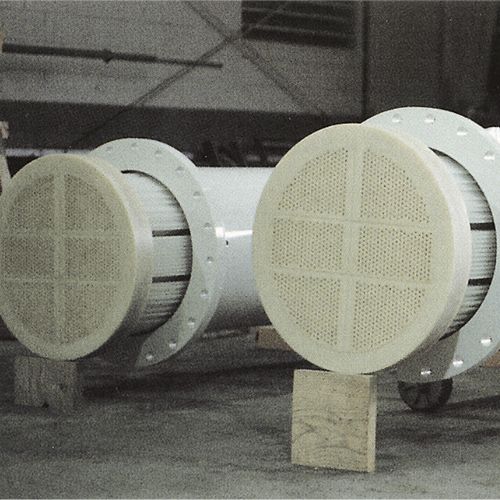
A polymer heat exchanger uses plastic or composite materials, instead of metals, for the heat transfer surfaces. This makes it particularly suitable for highly corrosive fluids that would attack metallic exchangers, such as concentrated acids, chlorinated compounds, or aggressive chemical streams. Polymer exchangers are lighter, resistant to scaling, and can offer a cost-effective alternative to exotic alloy equipment in specific applications.
Adding {{itemName}} to cart
Added {{itemName}} to cart